

Most American and European universities now use AI-detection tools to safeguard academic and business integrity. For freelance content writers and digital marketers, this means raw AI-generated text rarely stands up to scrutiny. If your work sounds mechanical or contains repetitive phrases, you risk rejection. This guide dives into proven methods that help you transform AI-produced content into genuinely human-sounding copy that consistently passes detection tests.
Table of Contents
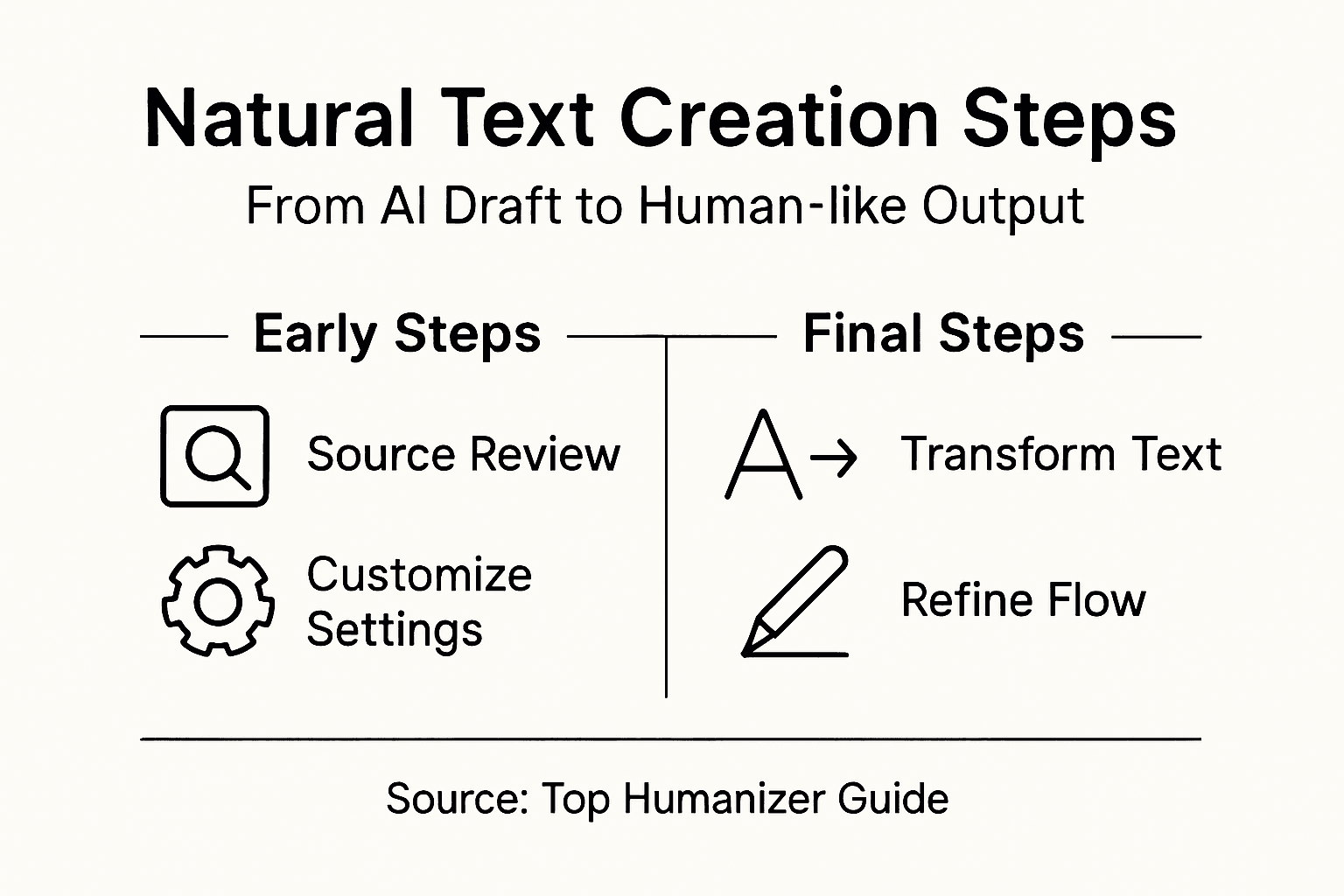
- Step 1: Prepare Your AI-Generated Source Material
- Step 2: Select Appropriate Customization Settings
- Step 3: Transform Text With A Humanizing Tool
- Step 4: Refine Content For Contextual Flow
- Step 5: Verify Output With Detection Tools
Quick Summary
| Key Insight | Explanation |
|---|---|
| 1. Review AI content for coherence | Carefully check the generated text for logical flow and remove segments that feel robotic or repetitive. |
| 2. Customize settings for tone | Adjust parameters to reflect the desired style and context, tailoring content specifically for its purpose. |
| 3. Utilize humanizing tools | Employ tools to refine language, enhancing readability and emotional nuance for more engaging content. |
| 4. Ensure narrative flow | Read draft aloud to check for disjointed sections and rearrange content to maintain a smooth logical progression. |
| 5. Test with AI detection tools | Run the content through multiple platforms to confirm it appears genuinely human-written, adjusting as needed. |
Step 1: Prepare your AI-generated source material
You're about to transform raw AI text into something that sounds genuinely human-written. This crucial first step involves carefully selecting and preprocessing your source material to create content that reads naturally. Retrieval-Augmented Generation strategies will help you understand how to optimize your initial text effectively.
Start by thoroughly reviewing your AI-generated content for structural integrity and contextual coherence. Look for sections that feel robotic or repetitive - these are prime candidates for humanization. Pay special attention to language patterns, sentence complexity, and overall flow. Your goal is to identify where the text sounds mechanical and needs human-like refinement. The key is understanding that Natural Language Generation involves more than just replacing words - it requires strategic restructuring.
Assess your source material across multiple dimensions. Check grammar consistency, eliminate unnatural phrasing, and ensure the content maintains its original meaning while becoming more conversational. This process requires a keen eye for nuanced language and an understanding of how humans actually communicate.
Pro tip: Create a side-by-side comparison document where you track specific changes, helping you develop a systematic approach to humanizing AI-generated text.
Step 2: Select appropriate customization settings
In this step, you'll learn how to fine-tune your AI-generated content to sound more authentically human. Retrieval-Augmented Generation frameworks offer powerful tools for tailoring your text to specific contexts and requirements, transforming generic AI output into personalized writing.
Customization involves strategic parameter adjustments that go beyond simple word replacement. Explore settings that control tone, style, and domain specificity. Consider the writing context - academic papers require different language nuances compared to marketing content or creative writing. Experiment with generation constraints that help eliminate robotic patterns and inject more natural conversational elements. Best practices from professional writers suggest focusing on human oversight and maintaining your unique voice throughout the customization process.
Pay close attention to subtle linguistic details. Adjust parameters like sentence complexity, vocabulary diversity, and contextual relevance. This means moving beyond default settings and deliberately crafting outputs that reflect human thought patterns and communication styles. Your goal is creating text that feels organic and genuine.

Pro tip: Create a personal style guide documenting your preferred customization settings to ensure consistent output across different writing projects.
Step 3: Transform text with a humanizing tool
In this critical stage, you will convert mechanical AI-generated text into engaging, authentic content that sounds naturally human. Techniques for humanizing content involve strategic refinements that breathe life into your writing, making it more conversational and compelling.
Start by uploading your AI-generated draft into the humanizing tool. Focus on areas that feel stiff or repetitive. The tool will help you vary sentence structure, inject emotional nuance, and smooth out awkward phrasing. Pay attention to how the software adjusts language patterns to sound more conversational. Look for improvements in readability and flow that transform your text from generic to genuinely engaging.
Review the transformed text carefully. Compare the original and humanized versions side by side, checking that the core message remains intact while the language becomes more natural. Assess whether the text now sounds like something a real person would write. Make manual adjustments if needed to preserve your unique voice and ensure the content truly reflects human communication patterns.
Pro tip: Run multiple iterations through the humanizing tool and save versions that capture different stylistic tones to find your optimal output.
Step 4: Refine content for contextual flow
You are about to elevate your AI-generated text from a mechanical draft to a polished narrative with smooth, logical progression. Academic writing refinement techniques provide critical insights into transforming generic text into a cohesive, contextually rich document.
Begin by reading your draft aloud to identify areas where the narrative feels disjointed or unnatural. Look for abrupt transitions, repetitive language patterns, and sections that lack clear logical progression. Advanced content coherence methods suggest focusing on creating a narrative that flows seamlessly, maintaining a consistent tone and voice throughout the document. Examine each paragraph critically to ensure it connects smoothly with the surrounding text, building a coherent argument or story.
Pay special attention to the overall structure. Reorganize paragraphs if needed to create a more intuitive progression of ideas. Check that each section builds upon the previous one, creating a logical narrative arc. Eliminate redundant information and fill in any gaps in reasoning. Your goal is to craft a piece of writing that reads so naturally that readers forget they are consuming AI-assisted content.
Pro tip: Create a mind map of your document's key points before editing to visualize the logical flow and identify potential structural improvements.
Step 5: Verify output with detection tools
Your final checkpoint involves strategically testing your humanized content against professional AI detection systems to ensure it passes scrutiny. Generative AI detection technologies offer sophisticated methods for evaluating the authenticity of your text, helping you confirm that your content appears genuinely human-written.
Select multiple detection platforms to run comprehensive tests. These tools analyze linguistic patterns, stylistic nuances, and statistical markers that might reveal AI origins. Advanced text detection approaches recommend running your content through various algorithms to assess potential detection risks. Pay attention to the specific feedback each tool provides about potential AI markers in your text, and be prepared to make additional refinements if any suspicious patterns emerge.
Remember that AI detection is an evolving field. No single tool offers a definitive verdict, so cross-reference results from multiple platforms. Look for consistent patterns across different detection systems. If one tool flags your content, carefully review and adjust those specific sections. Your goal is creating text that sounds so natural and authentic that it consistently passes professional detection scrutiny.
Pro tip: Maintain a log of detection tool results to track your improvement in creating undetectable AI-assisted content.
Compare types of AI detection tools and their usage:
| Tool Type | Analysis Focus | Best Used For |
|---|---|---|
| Linguistic pattern detector | Identifies unnatural phrasings | Spotting repetitive text |
| Stylistic analyzer | Checks style consistency | Ensuring tone matches humans |
| Statistical marker scanner | Finds AI-generated markers | Bypassing AI detectors |
| Multi-algorithm platform | Cross-references results | High-stakes authenticity checks |
Here's a quick summary of steps and their primary focus areas:
| Step | Main Action | Key Focus |
|---|---|---|
| 1 | Prepare AI-generated material | Check for coherence and flow |
| 2 | Customize settings | Adjust tone, style, context |
| 3 | Use humanizing tool | Improve naturalness and engagement |
| 4 | Refine for flow | Ensure smooth narrative |
| 5 | Verify with detection | Test for authenticity |
Elevate AI Text to Genuine Human Quality Today
Creating natural-sounding, human-like content from AI-generated drafts can be a complex journey filled with challenges like robotic phrasing, inconsistent tone, and detection risks. If you are striving to master concepts such as Retrieval-Augmented Generation and advanced humanizing tools while ensuring your text flows naturally and passes detection tools, you are not alone. These hurdles can slow your progress and threaten the authenticity of your work whether for academic papers, marketing strategies, or professional documents.
Top Humanizer offers a seamless solution that complements your step-by-step transformation process. By instantly refining AI outputs to sound fully conversational and organically human, our platform addresses key pain points such as eliminating repetitive patterns, customizing tone, and staying undetectable against Turnitin and GPTZero algorithms. With support for multiple languages, style customization, and airtight privacy protection, you can confidently accelerate your content creation without sacrificing quality or integrity.

Discover how to effortlessly humanize your AI-generated text and protect your originality right now. Visit Top Humanizer and start transforming your writing with proven methods that align perfectly with each crucial step detailed in the Step-by-Step Process for Natural-Sounding Text Creation. Don�t wait until detection issues jeopardize your work take control of your content�and elevate it today.
Frequently Asked Questions
How can I prepare my AI-generated material for natural-sounding text creation?
Begin by reviewing your AI-generated content for clarity and coherence. Look for robotic phrasing or repetitive sections, and then refine the text to enhance its flow and readability.
What customization settings should I adjust to improve my AI-generated text?
Focus on customizing parameters such as tone, style, and complexity to match the context of your writing. Experiment with various settings to create a text that feels more authentic and engaging.
What techniques can I use to transform mechanical text into engaging content?
Utilize humanizing tools to vary sentence lengths, enhance emotional nuance, and smooth out awkward phrasing. This step will significantly improve the naturalness of your writing and its overall appeal to readers.
How can I ensure that my content has a smooth and logical flow?
Read your draft aloud to identify disjointed areas and abrupt transitions. Revise paragraphs to create a coherent progression of ideas that builds upon each other for a more polished narrative.
What steps can I take to verify the authenticity of my text against AI detection tools?
Use multiple detection platforms to analyze your content for AI markers and linguistic patterns. Adjust any sections flagged by these tools to enhance the human-like quality of your writing and ensure it passes authenticity checks.
 March 27, 2026
 January 29, 2026