Let's be honest, making AI content "undetectable" isn't about pulling a fast one. It's about taking a sterile, robotic draft and breathing life into it. The real secret is layering in personality, a unique point of view, and the kind of nuanced language that algorithms just can't mimic. When you do this, you’re not just flying under the radar of detection tools—you’re making your content genuinely better.
Why 'Undetectable' Really Means More Human
It’s a uniquely frustrating moment for any writer or creator. You use an AI tool to get a solid first draft on the page, you spend your own time polishing it up, and then some detector still flags it as "AI-written." This sends a lot of people down a rabbit hole, trying to outsmart a piece of software.
But that’s a losing game. The goal shouldn’t be to fool a machine; it should be to create content so good that its origin doesn't even matter.
When we talk about how to make AI content undetectable, we're actually talking about quality. Instead of trying to scrub away the digital fingerprints, the real work is infusing the text with the very things that make human writing so compelling in the first place.
Shifting Your Mindset from Evasion to Enhancement
The biggest giveaway of raw AI output is its predictability. Language models are built to choose the most statistically probable next word, which is great for grammar but terrible for personality. The result is text that’s correct but completely soulless—it's often too formal and avoids the interesting quirks that give a writer a distinct voice.
This guide is all about reframing that challenge. We’re not looking for cheap tricks to bypass an algorithm. Instead, we're building a repeatable process to turn those sterile AI drafts into content that is truly:
- Authentic: It actually sounds like a real person with a unique perspective and tone.
- Nuanced: It moves past the obvious, surface-level information to offer subtle insights.
- Engaging: It uses a mix of sentence lengths, storytelling, and punchy language to keep a reader hooked.
Here's the bottom line: The best way to make AI content undetectable is to make it undeniably valuable. When you inject your own expertise, personal stories, and a clear voice, you're not just fooling a detector—you're creating something an AI could never have come up with on its own.
The Real Cost of Leaving Content Robotic
Relying on unedited AI drafts comes with some serious downsides. Readers have a built-in sensor for content that feels "off" or lacks a human touch, even if they can't quite put their finger on why. This gut feeling quickly leads to lower engagement, a dip in trust, and a totally missed chance to connect with your audience.
For marketers, students, and professionals, the stakes are even higher. Generic, vanilla content almost never ranks well on search engines because it lacks the signs of real-world experience and authority. In school, it can raise red flags for plagiarism. Learning to properly humanize your AI drafts isn't just about avoiding a penalty—it's about mastering an essential skill for creating content today. This guide will walk you through that exact workflow.
So, How Do AI Detectors Actually Work?
Before you can get your text to fly under the radar, you have to know what you’re up against. AI detectors aren’t magic. They're just incredibly sophisticated pattern-recognition machines, trained on massive libraries of human and AI writing to spot the statistical giveaways.
Think of it this way: an AI detector is like a bloodhound for robotic text. Instead of sniffing for a scent, it’s hunting for the digital fingerprints that large language models leave all over their work. These "fingerprints" are often so subtle that a human reader would never notice them, but they stick out like a sore thumb to an algorithm built to find them.
The Tell-Tale Signs of AI Writing
AI detectors zoom in on a few key characteristics of the text. While their exact methods are kept under wraps, they generally boil down to two core ideas that consistently separate machine-generated content from human writing: perplexity and burstiness.
Perplexity is just a fancy way of measuring how predictable your text is. Humans are wonderfully unpredictable. We use weird idioms, make strange connections, and choose words that an AI, which is basically a probability machine, would never dream of putting together. AI models, on the other hand, tend to play it safe. They almost always pick the most statistically common word to follow the last one, creating text with very low perplexity—a huge red flag for any detector.
Burstiness is all about the rhythm and flow of your sentences. When people write, it comes in bursts. We might craft a long, winding sentence with several clauses, then follow it up with a short, punchy one for impact. This creates a natural, varied reading experience. AI models, however, are built for consistency. They often spit out sentences that are all roughly the same length and structure, leading to a monotonous, robotic rhythm that detectors can spot from a mile away.
Here's the key thing to remember: AI detectors don't care what your content means. They can't judge its quality or accuracy. All they do is analyze its statistical makeup. This means a perfectly researched, factually correct article can still get flagged if its structure is too uniform.
This is a real problem in academic environments where integrity is everything. With research showing that a staggering 68% of teachers use AI detectors, it's critical for students who rely on AI for assistance to understand how these tools work. You can dig deeper into these numbers by checking out the latest AI detection stats and trends on browsercat.com.
Common AI Writing Patterns Flagged by Detectors
To really see the difference, it helps to put the two side-by-side. Here’s a breakdown of what detectors are looking for versus what natural human writing looks like.
| Characteristic | Typical AI-Generated Text | Natural Human Writing |
|---|---|---|
| Sentence Structure | Consistently uniform sentence lengths and simple, predictable structures. | A dynamic mix of long, complex sentences and short, direct ones. |
| Word Choice | Overly formal vocabulary and frequent use of common, high-probability words. | Uses a wider range of vocabulary, including idioms, slang, and specific jargon. |
| Flow and Transitions | Often relies on repetitive transitional phrases like "In conclusion," or "Additionally." | Employs more subtle and varied transitions that weave ideas together seamlessly. |
| Originality | Tends to state obvious facts and follow a very logical, but uninspired, path. | Introduces personal anecdotes, unique opinions, and unexpected connections between ideas. |
Once you really get the hang of perplexity and burstiness, your whole approach changes. You stop guessing what might get flagged and start editing with a clear strategy. You'll begin to spot that robotic uniformity in your own drafts and know exactly how to inject the human elements of surprise and variation.
Understanding this is the real foundation for turning any AI-assisted draft into something authentic and compelling. The rest of the process becomes a whole lot easier when you know exactly what you’re looking for.
A Practical Workflow for Humanizing AI Drafts
Alright, let's get down to brass tacks. It's one thing to talk about the theory of AI detection, but the real magic happens when you roll up your sleeves and get to work on a raw AI draft. Moving from that robotic first pass to a polished, human-sounding piece isn't about finding a single magic button. It's a hands-on editing process, designed to systematically break down AI patterns and weave your own voice into the text.
Think of an AI draft as a solid block of marble. The basic shape is there, but it’s your job as the sculptor to carve out the details, smooth the rough edges, and bring the final form to life. This workflow is your set of chisels.
Rebuilding the Foundation: Your Structure
The single most effective thing you can do first has nothing to do with words. It’s about tearing down the rigid, overly logical structure that AI models are known for. AI writing almost always follows a predictable A -> B -> C progression. It makes sense, but it’s also sterile and completely lacks narrative punch.
Your first pass should be all about the architecture. Don't be afraid to blow it up and rearrange the pieces. Ask yourself:
- Would the conclusion actually make a more compelling introduction?
- Does this supporting point hit harder if I move it to the front?
- Is there a better way to sequence these ideas to build a little curiosity?
By shuffling the flow, you instantly break that machine-like predictability. This one change is a massive first step toward making your content feel less like an algorithm and more like a conversation.
Mastering Sentence-Level Rhythm and Flow
Once the big picture is sorted, it's time to zoom in on the sentences. This is where you directly attack burstiness—that natural, uneven mix of sentence lengths that screams "human." AI tends to produce sentences of very similar length and structure, creating a monotonous, droning rhythm.
Your mission is to create a cadence that keeps your reader engaged.
- Combine the Short Stuff: Find those choppy, related sentences and weld them together. Use conjunctions ('and,' 'but,' 'so') or subordinate clauses to build more complex, descriptive thoughts.
- Chop Up the Long Ones: Hunt down those winding, run-on sentences. Break them into shorter, punchier statements. A short sentence lands with impact. Use them.
- Vary Your Openings: Do a quick scan. If half your sentences start with "The..." or "It is...", you have work to do. Rewrite them to start with a prepositional phrase, a question, or a different clause to add some much-needed variety.
Think of it like composing music. You need a mix of long, flowing notes and short, staccato beats to create a melody people want to listen to. The same goes for writing.
The image below shows the typical journey of unedited AI text straight into the arms of a detection tool.
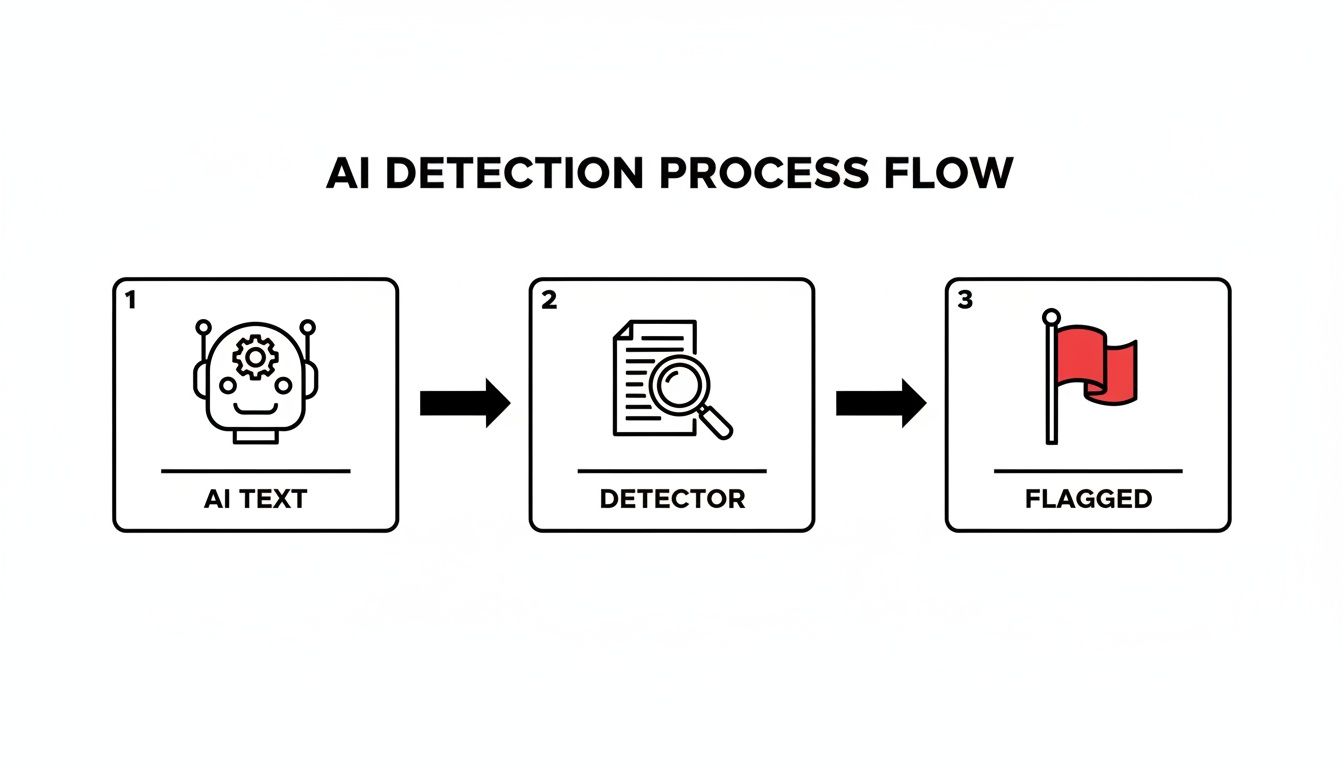
This process is exactly what we’re trying to interrupt. Our manual edits—disrupting the structure, varying sentences, and refining word choice—are all designed to break this predictable chain and avoid that "Flagged" outcome.
Choosing Words with Intent
Now we're at the micro-level: word choice. Because AI models are trained on the entire internet, they naturally gravitate toward the most common, generic, and frankly, boring words. The result is text that’s clear but completely forgettable. Your job is to swap out this vanilla vocabulary for words with more flavor and precision.
Instead of: "The system is very efficient." Try: "The system gets the entire workflow done in under 60 seconds."
The second version gives the reader a concrete, powerful image.
Look for places to sprinkle in:
- Idioms and Colloquialisms: Phrases like "hit the ground running" or "a blessing in disguise" add a human touch that AI still struggles to nail.
- Sensory Language: Use words that tap into the five senses. Make your writing more vivid and help it stick in the reader's mind.
- Stronger Verbs: Ditch weak verb-adverb combos (like "walked quickly") for a single, powerful verb (like "dashed" or "sprinted").
This is meticulous work, but it’s crucial. It's also an area where the stakes are high, especially for students. The drive to evade AI detection has unfortunately led to false positives, with some studies showing 5-15% of legitimate student work being incorrectly flagged. Understanding this context is critical, as detailed in this deeper look at AI content detection for educators.
Injecting Your Irreplaceable Voice
This is it. The final, and most important, layer. This is where you stop being an editor and become an author. This is the one thing no machine can ever truly replicate. Real humanization comes from weaving your unique perspective, your stories, and your personality into the text.
The ultimate goal isn't just to fly under the detection radar. It's to add real value that the AI could never have produced on its own. Your personal insight is the most powerful tool in your arsenal.
Go through the draft one last time and put your stamp on it.
- Where can I add a personal story or a quick anecdote to make a point?
- Can I offer a contrarian opinion or a fresh take on this topic?
- Is there a spot where I can inject a bit of humor, skepticism, or genuine passion?
By adding these elements, you're not just learning how to make AI content undetectable. You're transforming a generic data dump into something that connects with another human being. This last step ensures the work is truly yours, with the AI serving as the helpful, but silent, assistant it was always meant to be.
Taking Your Content to the Next Level
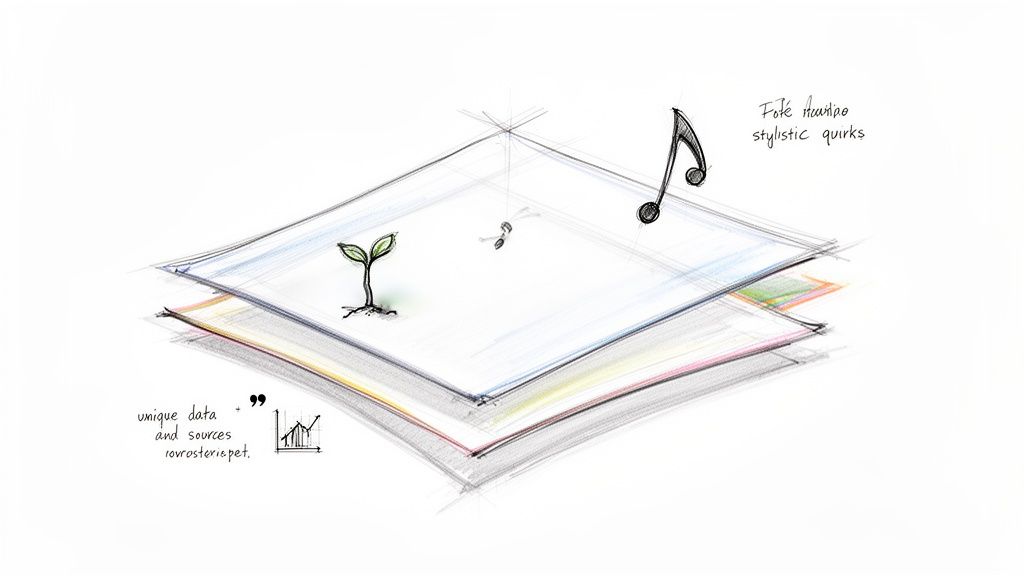
Alright, once you've tidied up the basic structure and sentence flow, it's time to dig into the more nuanced, artistic side of this process. These are the techniques that truly separate passable content from compelling, authentic work. They're especially critical for high-stakes content—think academic papers, major SEO cornerstone articles, or brand-defining thought leadership.
We're shifting gears here. This isn't about fixing robotic text anymore; it's about layering in sophisticated, subtle elements that AI just can't imitate. It takes a bit of creative thinking and a connection to the real world that, at least for now, remains a purely human skill.
Weave in Semantic Layers
Have you ever read an article where an idea from the beginning cleverly reappears in the conclusion? That's semantic layering. It's the art of weaving subtle themes, callbacks, or even a little foreshadowing throughout a piece. You're essentially leaving a trail of breadcrumbs for the reader.
An AI can march you from point A to point B, no problem. But it won't think to reference a metaphor from the intro with a clever twist of phrase in the final paragraph. That requires a long-form creative memory that models just don't have; they're stuck in the immediate context of the words they're generating now.
This layering creates a deeply satisfying, cohesive reading experience that feels intentional and masterfully crafted.
Learn to Love Imperfection
Let's be honest: perfect grammar, flawless transitions, and a monotonously even tone are dead giveaways for AI-generated text. Real human writing is full of wonderful little imperfections. We use conversational fillers, our phrasing can be a bit quirky, and sometimes we bend a grammar rule or two for impact.
The point isn't to be sloppy. It's about shattering the sterile, clinical pattern of machine text by adding stylistic quirks that feel genuine and relatable.
Try sprinkling in some of these small but powerful touches:
- Conversational Asides: Adding a quick, parenthetical thought—like this one right here—instantly makes your writing feel more personal and less stilted.
- Intentional Fragments: Sometimes, a short sentence works best. For emphasis. It shatters the monotony and creates a punchy, human rhythm.
- Your Own Quirks: Do you have a favorite way of phrasing things? A unique analogy you always use? Lean into it. These personal signatures are impossible for an AI to fake convincingly.
These so-called "imperfections" inject a personality that AI, in its obsession with correctness, is programmed to avoid. This is a huge part of learning how to make AI content undetectable—it’s about leaning into what makes us human, not just trying to be less robotic.
Ground Your Content in Exclusive Data
This is the most powerful technique in the playbook. You need to anchor your text in a reality that generic AI models can’t touch. Large language models were trained on the public internet; they have zero access to your company's internal reports, your personal experiences, or that exclusive interview you just landed.
This is your ace in the hole.
When you infuse your writing with proprietary information, it becomes instantly original and exponentially more valuable.
- Use Your Own Stats: Instead of quoting some tired, well-known statistic, pull data from your own surveys, case studies, or internal analytics.
- Get an Expert Quote: Email an expert in your field and ask for a unique quote. This adds a truckload of credibility and introduces a distinct human voice that was never part of the AI's training set.
- Tell a Quick Story: A brief, relevant anecdote from your own experience can illustrate a point far more effectively than a page of generic explanation ever could.
By integrating these exclusive elements, you create something that isn't just humanized—it's genuinely irreplaceable. You're adding new, valuable information to the world instead of just rehashing what's already out there. And that's the ultimate way to create content that is authentic, valuable, and completely beyond the reach of any detector.
Using an AI Humanizer for Speed and Consistency
Look, rewriting every single sentence by hand is the surest way to inject your unique voice into a piece. There's no substitute for it. But let's be realistic—that's not always an option.
When you're up against a tight deadline or have a mountain of content to get through, that detailed manual process can bring your entire workflow to a screeching halt. This is precisely where an AI humanizer can be a massive help. Think of it less as a replacement for a human editor and more as a powerful first-pass assistant.
How These Tools Actually Work
So what's happening under the hood? An AI humanizer is essentially a specialized rewriting tool. It takes that stiff, robotic AI text and reworks it to improve the two key metrics that detectors zero in on: perplexity (complexity) and burstiness (rhythm).
It’s designed to make the output statistically look like something a person would write.
A good tool, like Top Humanizer, tackles this by:
- Shuffling Sentence Structure: It automatically breaks up monotonous sentence patterns, sometimes combining short ones or trimming down longer ones to create a more natural flow.
- Improving Word Choice: It swaps out the predictable, overused vocabulary that AI models love for more nuanced synonyms and phrasing.
- Keeping Your Message Intact: The best humanizers are careful to preserve the core meaning of your text. After all, a rewrite is useless if it changes your facts or argument.
What would normally be a couple of hours of tedious editing can be done in seconds. For anyone pumping out thousands of words a week—bloggers, marketing teams, students—this kind of efficiency is a huge deal when learning how to make AI content undetectable.
What to Look For in a Good Humanizer
Not all of these tools are built the same. When you're picking one to add to your toolkit, you need to look past the basic rewrite function. The really useful platforms offer features that give you better control and, just as importantly, peace of mind.
The real value of a top-tier AI humanizer lies in its ability to act as a reliable partner in your content process—one that speeds up your workflow while respecting your privacy and specific needs.
Here are the non-negotiables:
- Customization Settings: You should be able to guide the output. Does it let you pick a specific tone or style? This is key for matching your brand voice or the requirements of an academic paper.
- A Rock-Solid Privacy Policy: This is critical. Make sure the tool has a clear no-storage policy. You need to be 100% sure your content isn't being saved on their servers or used to train their AI models.
- Proven Detector Evasion: A humanizer is only as good as its results. It needs to consistently get past a whole suite of detectors, from academic ones like Turnitin to professional ones like Originality.AI.
In the end, using an AI humanizer is a strategic move. You're automating the most mechanical, time-consuming parts of the editing process. This frees you up to focus on what really matters: adding your own insights, personal anecdotes, and unique perspective that no AI can replicate.
Frequently Asked Questions About Undetectable AI
Diving into AI-assisted writing naturally brings up a lot of questions. For a lot of us, this is new territory, so it's completely normal to wonder about the ethics, the real-world performance, and the nitty-gritty of making AI content sound human. Let's tackle some of the most common questions head-on.
Is It Ethical to Make AI Content Undetectable?
The ethics of humanizing AI-generated text really boils down to one thing: your intent.
Are you using AI as a brainstorming buddy, a tool to organize your scattered thoughts, or a way to bust through a nasty case of writer's block? If so, polishing that output is just a normal step in your creative process. You're the author; the AI is just your high-tech assistant.
The ethical red flag goes up when the goal is deception. Think submitting purely AI-generated work for a school assignment or trying to pass off raw machine text as your own hard-won expertise. The goal should always be to amplify your own skills and ideas, not to cheat or mislead someone.
Can Detected AI Content Still Rank on Google?
Google has been pretty clear that they reward high-quality, helpful content made for people, no matter how it was produced. The catch is that raw, unedited AI text almost never meets Google’s strict E-E-A-T (Experience, Expertise, Authoritativeness, Trustworthiness) standards. It just doesn't have real-world experience or genuine insight.
But here’s the interesting part: the very act of making AI content undetectable involves adding the human touches Google loves. You're injecting originality, a unique point of view, and valuable depth. So, well-humanized content has a much better shot at ranking well because the process itself makes the content better and more useful for the reader.
How Reliable Are AI Detection Tools?
Honestly, AI detectors are not the infallible judges they're often made out to be. They're far from perfect.
Countless studies and real-world tests have shown they can produce a surprising number of false positives, wrongly flagging text that was 100% written by a human. Their accuracy is all over the map, and it's common to see different tools give completely different scores for the exact same piece of writing.
This unreliability is a huge reason why people humanize their AI-assisted work in the first place. It’s a defensive move to keep their content from being penalized by a flawed algorithm, making sure it gets judged on its actual quality.
Will an AI Humanizer Guarantee My Content Is Undetectable?
The best AI humanizer tools out there are built from the ground up to rewrite text so it can consistently fly under the radar of today's most common detectors, like Turnitin and Originality.AI. They do this by intelligently changing up sentence structures, word choices, and the overall flow to mimic how a person actually writes.
Of course, no one can promise a 100% guarantee against some future, yet-to-be-invented detection technology. But the top platforms are constantly evolving. They update their systems to stay ahead of new detection methods, giving you a very high degree of reliability against the tools being used right now.
Ready to turn your AI drafts into authentic, polished content that connects with your audience and sails past detectors? Top Humanizer uses sophisticated algorithms to humanize text in seconds, keeping your message intact while delivering a natural, undetectable result. Try Top Humanizer today and see the difference for yourself!
 March 27, 2026