Think of an AI text humanizer as a finishing tool. It takes the raw, often clunky content produced by an AI and polishes it until it reads like something a person actually wrote. The goal is to smooth out the robotic sentence structures and word choices so the text can get past AI detection systems.
Why AI Content Needs a Human Touch
Let's be honest, AI can churn out content at a mind-boggling speed. You can get a full blog post, an essay, or a batch of marketing emails in the time it takes to make a cup of coffee. But there’s a catch. The final product often feels… off. It’s sterile, predictable, and missing that spark of genuine human connection.
That machine-like quality is exactly what AI detectors are trained to sniff out.
This creates a real headache for a lot of people:
Students are on edge, worried their AI-assisted homework will get flagged by systems like Turnitin.
Bloggers and SEOs know that search engines prioritize content that genuinely engages readers, and robotic text just doesn't cut it.
Marketing agencies face the challenge of creating tons of content for clients without it all sounding like it came from the same cookie-cutter template.
The root of the problem is that AI models, for all their power, tend to fall into predictable patterns. They use similar sentence lengths, repeat certain words, and follow a rhythm that just doesn't feel natural. Human writing is messy, varied, and full of personality—the very things AI struggles to copy on its own. That's where an AI text humanizer steps in to bridge the gap.
The Rise of the AI Detection Arms Race
The explosion of AI writing tools has inevitably led to the creation of equally powerful detection technology. The AI writing market was valued at a huge $392 million in 2022 and is expected to rocket to over $1.4 billion by 2030. With that much AI-generated content flooding the internet, the pressure to tell human and machine writing apart has never been higher. You can dig into this explosive growth in recent industry reports.
What we're seeing is a classic technological arms race. AI writers get smarter, and AI detectors get better at finding their digital fingerprints.
An AI text humanizer is built to win this race. It’s not just a fancy synonym-swapper. It fundamentally rewrites the text's DNA to mirror the subtle quirks and creative flair of a human writer.
By intelligently tweaking sentence structure, injecting more diverse vocabulary, and varying the overall complexity, these tools make AI content virtually indistinguishable from the real thing. It’s the key to keeping the speed of AI without sacrificing the authenticity needed to pass detectors and truly connect with an audience.
How AI Humanizers Outsmart Detection Algorithms
So, how does an AI text humanizer actually pull this off? It's all about breaking predictable patterns.
Think of it this way: standard AI-generated text is like a perfectly programmed drum machine. It's precise, consistent, and hits every beat exactly on time. Technically, it's flawless, but it lacks a soul. There's no surprise, no flair.
Human writing, on the other hand, is like a live jazz drummer. It's full of improvisation, unexpected pauses, and unique flourishes. That natural variation—the "human element"—is precisely what AI detectors are trained to spot. When it's missing, the text screams "machine-written."
This is where a humanizer steps in, acting as a creative translator to turn robotic output into something that genuinely connects with people.
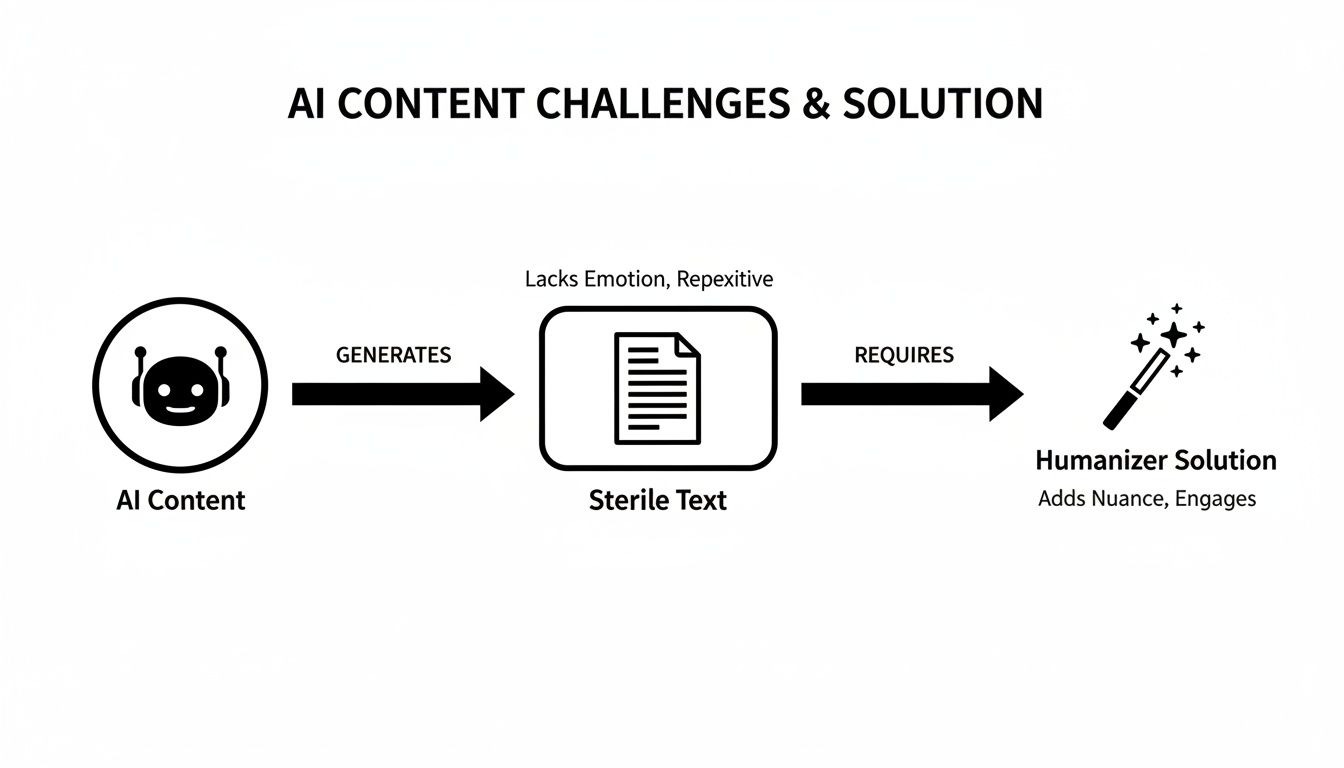
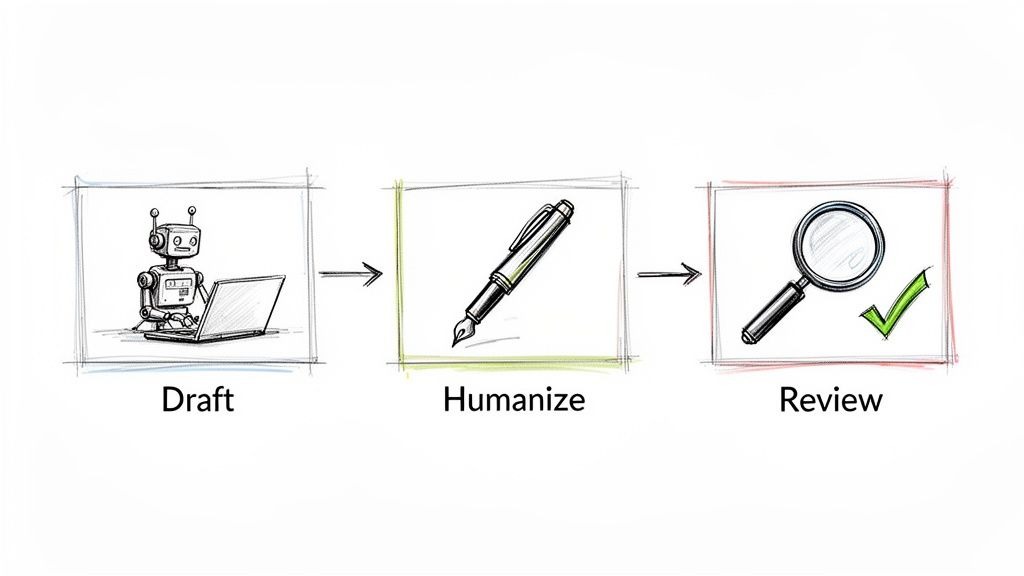
As you can see, the humanizer is the essential bridge between sterile machine output and engaging, reader-friendly content.
Cracking the Code: Perplexity and Burstiness
AI detectors aren't magic; they're just really good pattern-finders. They primarily look for two tell-tale signs of AI writing: low perplexity and low burstiness. These might sound technical, but they're pretty simple concepts.
Perplexity is just a fancy way of measuring how predictable a piece of text is. AI models are built to choose the most statistically likely word to come next, which often results in safe, common, and—let's be honest—boring language. Human writing is far less predictable. We use surprising words and creative phrasing, which gives our writing high perplexity.
Burstiness is all about sentence variety. Humans don't write in a monotone. We mix it up—a short, punchy sentence here, a longer, more descriptive one there. This creates a natural rhythm. AI models, however, often produce sentences of similar length and structure, resulting in a flat, robotic cadence.
AI detectors are essentially looking for writing that's too perfect. They flag text with predictable word choices (low perplexity) and uniform sentence structures (low burstiness). An AI text humanizer is designed specifically to mess up those patterns.
By introducing more interesting vocabulary and varying the sentence flow, a tool like Top Humanizer can effectively erase the digital fingerprints that detectors from GPTZero to Originality.AI are looking for.
The Humanizer’s Bag of Tricks
A sophisticated AI text humanizer does more than just swap a few words. It performs a deep-level rewrite, focusing on a few key areas to make the text sound genuinely human.
Varying Sentence Structure: It actively breaks up monotonous rhythms by mixing short, direct statements with more complex, compound sentences. This creates the "burstiness" that detectors associate with human writers.
Elevating the Vocabulary: Instead of just finding synonyms, it introduces more nuanced and context-appropriate words that a standard AI might not consider, instantly boosting the text's perplexity.
Weaving in Idioms and Natural Phrasing: Humanizers can sprinkle in common idioms and colloquialisms that make the writing feel more authentic and conversational. It’s a subtle but incredibly effective trick.
Refining Tone and Flow: A good humanizer also acts like a human editor, rephrasing ideas to improve clarity and ensure the tone remains consistent with the original message.
The difference is night and day. Let's break it down in a simple comparison.
Comparing AI-Generated vs Humanized Text
This table highlights the clear transformation that occurs when a piece of content is run through a quality humanizer.
Characteristic | Typical AI-Generated Text | Humanized Text |
Sentence Flow | Uniform and often repetitive sentence lengths. | Varied and dynamic, with a mix of short and long sentences. |
Word Choice | Predictable, safe, and common vocabulary. | Creative, nuanced, and less common words that add depth. |
Originality | Often gets flagged by detectors like Turnitin or GPTZero. | Bypasses detection by mimicking human writing patterns. |
Engagement | Can feel sterile, robotic, and disconnected. | Reads naturally and connects with the audience. |
In the end, it's about reverse-engineering the AI writing process. While a generative model searches for the most probable path, an AI text humanizer deliberately introduces the creative unpredictability that defines human expression. It's the strategic addition of these "perfect imperfections" that makes all the difference.
Real-World Scenarios for Using an AI Text Humanizer
So, where does an AI text humanizer actually fit into the picture? Its real value shines when you see who's using it and, more importantly, why. This isn't some niche gadget for tech geeks; it’s a practical solution for real problems that students, writers, and marketing teams face every single day.
Let's dive into the specific situations where a humanizer stops being a "nice-to-have" and becomes an essential part of the workflow.
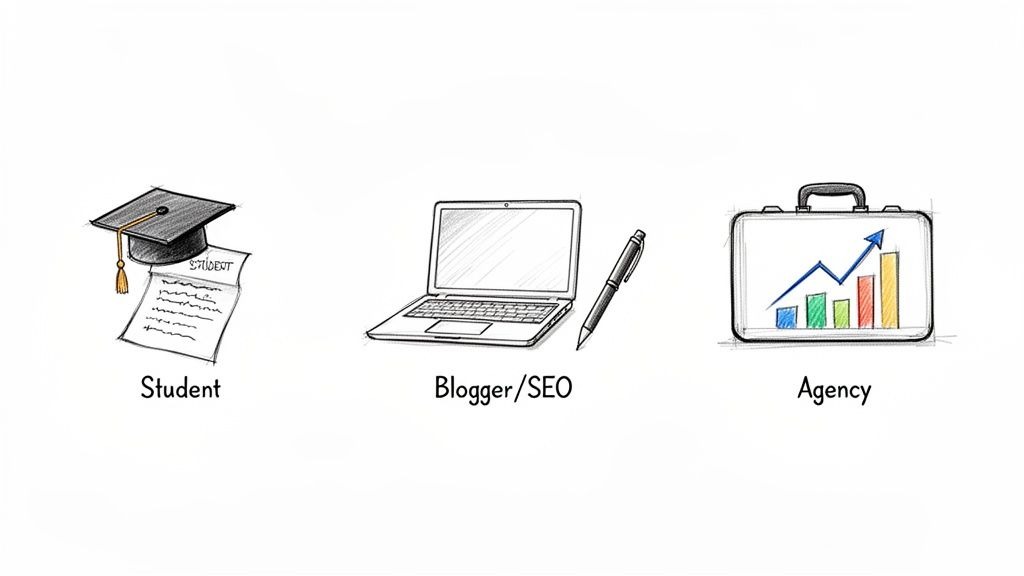
From the dorm room to the boardroom, the need for content that feels genuinely human is universal. Each of these groups has a unique headache, and these tools are the perfect medicine.
Students Navigating Academic Integrity
Students are under constant pressure. They need to crank out high-quality essays, often on impossible deadlines. AI writing tools can be a lifesaver for brainstorming or getting a first draft down, but there’s a catch: the output is often a dead giveaway for academic integrity software like Turnitin. This is a huge risk, since even an accidental flag can spell serious trouble.
Imagine a student using AI to help outline a complicated literature review. The initial draft is factually okay, but it lacks the critical, analytical voice that professors look for. It just sounds… generic. The spark of genuine thought is missing.
This is where an AI text humanizer becomes the critical bridge. By running that AI-assisted draft through a tool like Top Humanizer, a student can:
Fix Robotic Phrasing: It helps turn clunky, machine-like sentences into smooth prose that actually sounds like them.
Steer Clear of Detection: The text is restructured to avoid the patterns that tools like Turnitin are designed to catch.
Make it Clearer: It improves the flow and readability, making sure their arguments land with impact.
The point isn't to cheat. It's about using AI as a legitimate writing assistant without getting penalized for its robotic fingerprints. The humanizer is that final polish that makes the work authentic and truly representative of the student’s own knowledge.
Bloggers and SEO Experts Chasing E-E-A-T
For bloggers and SEO pros, the rules of the game have completely changed. Google is all about E-E-A-T (Experience, Expertise, Authoritativeness, and Trustworthiness), and that means thin, generic content gets buried. Both people and search engines can spot a soulless, AI-generated article from a mile away.
Think about an SEO expert who needs to create a dozen articles on a highly technical subject. Using AI can save an enormous amount of time on research and drafting. But the raw output often reads like a dry encyclopedia entry, not a helpful guide from someone who’s actually been in the trenches.
By humanizing their AI-generated drafts, content creators can align their work with E-E-A-T principles, ensuring the final article sounds like it was written by a knowledgeable expert, not a machine.
An AI text humanizer gets them there by:
Injecting a Natural Tone: It can add conversational touches and a more personal voice, which keeps readers hooked.
Boosting Readability: The tool reworks repetitive sentence structures, which can improve key metrics like time spent on the page.
Keeping the SEO Juice: A good humanizer refines the language without gutting the important keywords, so the article can still rank.
This lets them keep up with a demanding publishing schedule without sacrificing the quality that builds a loyal following and wins favor with Google.
Marketing Agencies Scaling Content Production
Marketing agencies live in a state of constant hustle. They need to pump out steady, high-quality content for a bunch of different clients, and each client has its own unique brand voice and audience. AI is essential for keeping up, but it also creates the risk of producing bland, one-size-fits-all content that doesn't capture anyone's brand personality.
One day, an agency might need to create social media campaigns, blog posts, and email newsletters for ten different clients. If they use the same basic AI writer for all of them, everything starts to sound eerily similar.
This massive demand is exactly why AI text humanizers have exploded in popularity. In fact, the need from students, marketers, and agencies has pushed some platforms past 6 million users, with many reporting productivity jumps of up to 41%. You can dig deeper into this trend and the growth of AI text humanization tools.
For an agency, an AI text humanizer is a non-negotiable tool for protecting brand integrity at scale. It lets them:
Customize the Brand Voice: They can tweak AI drafts to perfectly match a client’s tone, whether it’s buttoned-up professional, witty and playful, or deeply inspirational.
Guarantee Consistency: It ensures that every piece of content in a campaign, from a tweet to a whitepaper, feels cohesive.
Massively Boost Efficiency: The team can get from a raw AI draft to a polished, client-ready piece in a fraction of the time, cutting down on tedious manual edits.
At the end of the day, a humanizer lets agencies get the speed of AI without losing the custom, brand-focused quality that their clients pay for.
Choosing the Right AI Text Humanizer for Your Goals
With so many tools popping up, picking the right ai text humanizer can feel like finding a needle in a haystack. They aren't all built the same, and a bad choice can leave you with mangled text that still gets flagged. To find one that actually works, you have to look past the flashy ads and zero in on what truly matters.
First things first: does it actually beat the detectors? A humanizer is pretty useless if its output can't get past heavy hitters like Turnitin, GPTZero, or Originality.AI. Look for platforms that are upfront about their performance and are constantly tweaking their tech to stay one step ahead. This is the absolute baseline.
But just slipping past detectors isn’t enough. A good humanizer also has to preserve the original meaning and tone of your writing. The whole point is to refine the text, not rewrite your core message into something unrecognizable. The best tools act like a skilled human editor, smoothing out robotic phrases while keeping your argument and voice perfectly intact.
Key Features to Look For
When you start comparing options, it helps to have a mental checklist. Focusing on these features will help you pick a tool that’s right for your specific needs, whether you're writing an essay, a blog post, or a report for a client.
High Evasion Rate: The tool needs a solid track record. Can it consistently produce content that goes undetected by the big names? Look for real user reviews or case studies that mention success with the toughest detectors.
Meaning and Tone Preservation: Your message is king. The tool has to be smart enough to understand context and nuance, rewriting sentences without gutting their original intent.
Speed and Volume: How fast can it work? If you’re on a tight deadline or have a massive document, a tool that can process thousands of words in under a minute is a game-changer.
Customization and Style Controls: The best humanizers give you options to tweak the output. This is crucial for matching the text to your personal writing style or a specific brand voice, giving you more command over the final result.
These are the core functions that separate a genuinely helpful writing partner from a frustrating waste of time.
Don't Overlook Security and Privacy
In the rush to humanize a piece of content, it’s easy to forget about who’s seeing your text. You're often pasting sensitive stuff into these tools—from unpublished research to confidential marketing plans. That’s why a tool’s security measures are just as important as its rewriting skills.
A trustworthy ai text humanizer should offer serious security. Look for platforms that use enterprise-grade encryption to protect your data while it’s being processed.
But the single most important security feature is a strict no-storage policy. This guarantees the provider doesn't save or log your text on their servers once the job is done. Your intellectual property stays yours, and only yours.
This commitment to privacy is a must-have for professionals and students who need to maintain confidentiality. For instance, a platform like Top Humanizer has a firm no-log policy, giving users peace of mind that their work is always secure.
Making Your Final Decision
At the end of the day, the right ai text humanizer for you really depends on your goals. A student’s main worry might be getting past Turnitin, while a marketing agency will care more about brand voice consistency and handling large volumes of content quickly.
Here’s a simple way to approach your choice:
Define Your Main Goal: What are you writing? Essays, blog posts, or client emails? Your primary use case will tell you which features matter most.
Test It Out: Before you commit, use a free trial to run a sample of your own AI-generated text through the tool. Check the output for quality, clarity, and, of course, a human touch.
Run It Through Detectors Yourself: Don't just take the tool's word for it. Paste the humanized text into free checkers like GPTZero to see if it actually passes.
Check the Privacy Policy: Seriously, take two minutes to read it. Confirm they have a no-storage rule and clear data protection standards.
By following these simple steps, you can confidently pick an ai text humanizer that not only makes your content sound authentic but also fits your workflow and keeps your data safe.
A Smart and Ethical Way to Use an AI Humanizer
Let's be real: just plugging AI text into a tool and hitting "humanize" isn't a winning strategy. To get truly great content, you need a smart process. Think of an AI text humanizer as an incredibly talented assistant, not a magic button that replaces your own judgment. The best workflow always keeps you in the driver's seat as the final editor, making sure the end result is accurate, high-quality, and actually connects with people.
This entire approach can be broken down into a simple, three-stage journey that takes a robotic AI draft and turns it into something polished and ready to publish.
Step 1: Start with a Strong AI Draft
First things first, fire up your go-to AI writer, whether it's ChatGPT or another model you like. The goal here is to get a solid first draft. Don't worry about perfection; focus on getting the main ideas, structure, and key talking points on the page. Speed is your friend at this stage.
Think of it like a sculptor shaping a lump of clay. You're just getting the basic form down—the fine-tuning and artistic details come later.
Step 2: Refine and Humanize the Text
With your draft in hand, it's time to bring in the specialist. Copy the text from your AI writer and paste it into a reliable humanizer like Top Humanizer. This is where the magic really happens. The tool gets to work breaking down those tell-tale robotic phrases and predictable sentence patterns.
Here’s what a good humanizer does:
Boosts Perplexity and Burstiness: It rewrites sentences and swaps out common AI words for a more varied vocabulary, making the text read like it came from a real person.
Improves Readability: The tool smooths out clunky transitions and improves the overall flow, so the content is far more engaging and easy to read.
Evades Detection: By scrubbing away the digital fingerprints left by AI models, it ensures your content can confidently pass through detection tools.
This step is the bridge between a raw, machine-generated draft and a piece of writing that has genuine stylistic flair.
Step 3: Do a Final Human Review
This last step is absolutely essential and is what separates decent content from truly exceptional work. Once the AI text humanizer has done its part, it's your turn to step in as the editor-in-chief. Your expertise is the one thing no tool can replicate.
During your final pass, be sure to:
Fact-Check Everything: AI models can "hallucinate" and just make things up. Double-check every statistic, date, and claim to ensure your content is 100% accurate.
Inject Your Own Insights: Add personal anecdotes, unique opinions, or industry-specific examples. This is what makes your content stand out and builds real authority.
Match Your Brand Voice: Fine-tune the tone and style so it perfectly aligns with your brand's personality or the specific guidelines for an academic paper.
Read it Out Loud: This is the ultimate test. Reading your work aloud helps you catch any lingering awkward sentences or logical gaps that your eyes might have missed.
This three-step workflow—Draft, Humanize, Review—gives you the best of both worlds: the incredible speed of AI paired with the irreplaceable authenticity of a human expert.
By adopting this process, you can integrate an AI text humanizer into your work responsibly. It allows you to produce high-quality, undetectable content at scale while still respecting institutional guidelines by ensuring human accountability is at the core of everything you create.
Common Questions About AI Text Humanizers
Once you start looking into AI humanizers, a lot of questions pop up. It’s a new space, and everyone wants to know how these tools really work, where the ethical lines are, and what the practical risks might be. From SEO to the cat-and-mouse game with AI detectors, let’s clear up the confusion.
This section gets straight to the point, answering the most common questions we hear so you can get a complete picture of what to expect.
Will Using an AI Humanizer Hurt My SEO?
This is the big one for anyone creating content online. The good news? When you use a quality humanizer the right way, it can actually give your SEO a boost. The fear that Google will penalize you is based on a slight misunderstanding. Google isn't on a mission to hunt down all AI-assisted content; it's trying to get rid of bad content—the spammy, unhelpful stuff that offers no real value.
Think about Google’s E-E-A-T guidelines (Experience, Expertise, Authoritativeness, and Trustworthiness). Raw AI text often falls flat here. It can sound generic, repeat itself, and completely miss the spark of a real human perspective. That kind of sterile content makes people click away fast, sending negative signals to search engines that can kill your rankings.
A good humanizer tackles this head-on. It reworks clunky phrasing, mixes up sentence structures, and gives the text a natural rhythm that makes it readable and engaging. When people stick around to read what you've published, Google takes that as a sign of quality. You're not just dodging detectors; you're using a tool to align your content with the very things search engines want to see.
The real job of an ai text humanizer isn't just to be sneaky—it's to elevate AI drafts into high-quality, human-centric content. That focus on the reader experience is exactly what modern SEO is all about.
Can AI Detectors Eventually Beat All Humanizers?
The dynamic between humanizers and detectors feels a lot like the endless battle between antivirus software and viruses. One side makes a move, and the other learns to counter it. So, while detectors will certainly get smarter, it's highly unlikely they'll ever "win" outright. Why? Because humanizers are chasing a target that's always moving: human creativity.
AI detectors work by spotting patterns. They look for predictable word choices and unnaturally consistent sentence lengths—the statistical fingerprints that AI writers tend to leave behind. The best AI humanizers are built specifically to shatter those patterns. They don't just swap a few words around; they fundamentally rewrite the text to introduce the beautiful, slightly messy-in-a-good-way chaos of human expression.
As the AI models that write content get better, so do the models designed to humanize it. The top tools are constantly updated to learn new writing styles and stay ahead of the latest detection tricks. As long as people keep writing in unique and unpredictable ways, humanizers will have a blueprint to follow that detectors will always struggle to pin down. The goal is to make the text statistically identical to something a person wrote, which keeps the best humanizers one step ahead.
Is It Ethical for Students to Use These Tools?
This is a tricky area, and the answer really comes down to how a student is using the tool. If the goal is to generate an entire essay with AI and use a humanizer to pass it off as their own work, that's a clear violation of academic integrity. It's just a high-tech form of cheating.
But the lines get blurrier when a humanizer is used more like a sophisticated writing assistant—a step up from a grammar checker. A student might use AI to brainstorm talking points or simplify a complex topic. The text that comes out is often robotic and poorly organized. Using a humanizer at this stage to clean up that rough draft and make it flow better can be a legitimate part of the writing process.
The key here is ownership and accountability. An ethical approach would look something like this:
Use AI for Ideas: Start with AI as a brainstorming partner or research assistant.
Humanize for Flow: Run the rough, clunky draft through a humanizer to improve its structure and readability.
Inject Your Own Thinking: This is the most important step. The student must go back through the text, add their own analysis, fact-check everything, and rewrite sections to ensure the final paper reflects their genuine understanding.
When it's a tool for polishing and not for deceiving, an ai text humanizer can be a helpful resource. But students should always check their school's specific policies on using AI tools.
How Do These Tools Handle My Data Privacy?
This is a huge deal, and rightly so. You're pasting potentially sensitive content—unpublished blog posts, proprietary business plans, academic research—into a third-party tool. You have to be able to trust that your data is safe. A reputable ai text humanizer will make your privacy a top priority.
The single most important thing to look for is a strict no-log policy. This is a promise that the service does not save your text on its servers once the humanization is done. The tool should process your request in the moment and then immediately forget it ever existed. This keeps your work from being stored, sold, or used to train other AI models.
Beyond that, make sure the platform uses strong, enterprise-grade encryption. This protects your data as it travels from your computer to their servers, making it useless to anyone who might try to intercept it. For instance, a trusted tool like Top Humanizer is built on a no-log foundation and uses robust encryption, giving you peace of mind that your intellectual property stays yours. Before using any tool, take a minute to read its privacy policy—it’s worth it.
Ready to transform your AI text into compelling, undetectable content? Top Humanizer offers the advanced technology you need to bypass AI detectors while preserving your original meaning and tone. Try Top Humanizer today and experience the difference for yourself!
 March 27, 2026
 January 29, 2026